Monday, February 20, 2006

Nigerian Scams

You've heard of the Nigerian email scams. Someone sends you an email telling you that a relative has died in a plane crash along with wife and only child. You have been deemed to be the closest relative and entitled to their estate worth millions. All you have to do is send name, address, phone, Social Security number, passport numbers, and bank information. Once they have verified that you are the heir to the estate, they will send the money to your bank account.

There are other variations on the theme. One is the widow of a high ranking government or banking official. Sometimes she is dying and wants her money (again in the millions) to be distributed to the poor, but she's afraid that her greedy relatives won't carry out her wishes.

Another is a mid or upper level banking or government official has uncovered an account worth millions - sometimes overpayments made an oil or construction company - that is about to be found out by corrupt officials who will seize the money for their own benefit.

There are other variations, but they are all the same. They have found your name through a registry or other vaguely described place. They want to get the money out of their country (usually Nigeria, but Russia, Saudi Arabia and South American countries are being used also) and want you to be their agent on this end. You will be well compensated, of course.

Okay, let's say you send them the information they want. You know what you'll get in return? An empty bank account and a stolen identity. You've given them enough, more than enough, actually, information to make your life a living hell for years to come. Do not ever send them any personal information. Don't even send them your telephone number, much less bank account numbers. Actually, I did think of sending them them the Washington FBI address and telephone numbers, but hadn't gotten around to looking them up.

I've somehow managed to get on a mailing list for these scams. I was getting one or two a week, and then one or two a day, and then several in one day. No, I didn't give them information they didn't already have. They had my email, and that's all they had and all they would get. I don't keep much personal information on my computer, so they couldn't find much.

Anyway, I played with a couple of them. Replied, asked questions. Showed I was as greedy as they and asked for money up front. Of course, all I got back was a hard time because I was so greedy. Well, I didn't really have time to play with them, and I'm not sure I was up to playing their games, so I came up with another idea.

I added each of them to my email directory and as I got another email, I forwarded that email to each of the ones in my contacts list. I figured that if they wanted someone who was stupid and greedy, they might as well talk to one of their own.

Since last Thursday when I started this, I haven't received a single email scam. Of course, most of the ones I sent out were bounced back. Their email accounts were closed even before I sent them out. Their ISP's figured out they were scamming, or they closed down on their own, or, I don't know what. But, I haven't gotten any more.

I don't think they like me any more.

::sigh:: I feel so unloved.

Update: They must love me again! I've gotten a couple more! And Jack's Shack reports that "I have been having a most enjoyable time corresponding with a Mr. Shola Rhodes." Jack! Tell us more! Inquiring minds want to know!
A Real Friend Test

A simple friend, when visiting, acts like a guest.
A real friend opens your refrigerator and helps himself.

A simple friend has never seen you cry
A real friend has shoulders soggy from your tears.

A simple friend doesn't know your parents' first names.
A real friend has their phone numbers in his address book.

A simple friend brings a bottle of wine to your party.
A real friend comes early to help you cook and stays late to help you clean.

A simple friend hates it when you call after he has gone to bed. A real friend asks you why you took so long to call.

A simple friend seeks to talk with you about your problems.
A real friend seeks to help you with your problems.

A simple friend wonders about your romantic history.
A real friend could blackmail you with it.

A simple friend thinks the friendship is over when you have an argument.
A real friend calls you after you had a fight.

A simple friend expects you to always be there for them.
A real friend expects to always be there for you!
A Valentine for Osama

Little Thelma comes home from first grade and tells her father that they learned about the history of Valentine's Day. And, "Since Valentine's Day is for a Christian saint and we're Jewish," she asks,"will God get mad at me for giving someone a valentine?"

Thelma's father thinks a bit, then says "No, I don't think God would get mad. Who do you want to give a valentine to?"

"Osama Bin Laden,"she says.

"Why Osama Bin Laden?" her father asks in shock.

"Well," she says, "I thought that if a little American Jewish girl could have enough love to give Osama a valentine, he might start to think that maybe we're not all bad, and maybe start loving people a little bit. And if other kids saw what I did and then they sent valentines to Osama, he'd love everyone a lot. And then he'd start going all over the place telling everyone how much he loved them and how he didn't hate anyone anymore."

Her father's heart swells and he looks at his daughter with newfound pride. "Thelma, that's the most wonderful thing I've ever heard."

"I know,"Thelma says, "and once that gets him out in the open, the Marines could blow him all to Hell."

Image hosting by Photobucket

A girl after my own heart - ed.

From email

Sunday, February 19, 2006

Image hosting by Photobucket
Current US Medal Count

Speed Skating Image hosting by Photobucket

Gold: Chad Hedrick - Speed Skating - 5000m
Gold: Shani Davis - Speed Skating - 1000m
Gold: Joey Cheek - Speed Skating - 500m
Silver: Joey Cheek - Speed Skating - 1000m
Bronze: Apolo Anton Ohno - Speed Skating - Short Track 1000m


SkiingImage hosting by Photobucket

Gold: Ted Ligety - Alpine Skiing - Men’s Combined
Bronze: Toby Dawson - Freestyle Skiing – Moguls

Image hosting by Photobucket
Snowboarding

Gold: Shaun White - Snowboarding - Halfpipe
Gold: Hannah Teter - Snowboarding – Halfpipe
Gold: Seth Wescott - Snowboarding - Snowboard Cross
Silver: Lindsey Jacobellis - Snowboarding - Snowboard Cross
Silver: Danny Kass - Snowboarding – Halfpipe
Silver: Gretchen Bleiler - Snowboarding – Halfpipe
DID YOU KNOW?

As you sit inside the courtroom, you can see the wall, right above where the Supreme Court judges sit, a display of the Ten Commandments!

Image hosting by Photobucket

Part 3

Thursday, February 16, 2006

Why Dogs Don't Live As Long As People...

Being a veterinarian, I had been called to examine a ten-year-old Irish Wolfhound named Belker. The dog's owners, Ron, his wife Lisa, and their little boy, Shane, were all very much attached to Belker and they were hoping for a miracle. I examined Belker and found he was dying of cancer. I told the family there were no miracles left for Belker, and offered to perform the euthanasia procedure for the old dog in their home. As we made arrangements, Ron and Lisa told me they thought it would be good for the four-year-old Shane to observe the procedure. They felt as though Shane might learn something from the experience.

The next day, I felt the familiar catch in my throat as Belker's family surrounded him. Shane seemed so calm, petting the old dog for the last time, that I wondered if he understood what was going on. Within a few minutes, Belker slipped peacefully away. The little boy seemed to accept Belker's transition without any difficulty or confusion. We sat together for a while after Belker's death, wondering aloud about the sad fact that animal lives are shorter than human lives. Shane, who had been listening quietly, piped up, "I know why."

Startled, we all turned to him. What came out of his mouth next stunned me. I'd never heard a more comforting explanation. He said, "People are born so that they can learn how to live a good life -- like loving everybody all the time and being nice, right?" The four-year-old continued, "Well, dogs already know how to do that, so they don't have to stay as long."

from email
Delta - Part 2

Jane posted this in response to my post. I suggest we all check out the link she provided. Thanks Jane! This is something that I now have an interest in.

--------------------------------------------

As far as I know this story is indeed true, however Hole in the Wall Rescue is mine and I am not the person who had the experience with the airline. Someone just left my signature on it when it was reposted.

For a lot more information on how airlines do business please go to: http://ucat.us/airline-loss-reports.html

# posted by JaneGael : 2/14/2006 9:14 PM
Figure Skating

That's probably my favorite sport in the Olympics, both singles and pairs, followed by ice dancing. So elegant and so dynamic at the same time.

There's a new scoring system in place after the scandal four years ago. I have no idea how it works, and since I'm not a judge nor a skate, I really don't care. As long as politics remain out of it and each skater is judged on their ability and presentation, then I can accept whoever wins. Sure, I pull for the USA skaters, but, really, do you remember who won four years ago? I don't. I may remember skaters, but I couldn't begin to remember much more. I may love skating, but it's not something that I follow closely.

I've only ice skated once in my life. I did very well...then I got on the ice. I don't think I fell, but I spent my time hanging on to the fence for dear life! I'm glad that the commentators are there to tell me what I'm seeing. I watch and think that they are all absolutely fabulous. Unless they fall, and even then I think they're darn good!
Image hosting by Photobucket
Curling

I can see how curling is sort of like watching grass grow to many people. I don't pretend to know the first thing about it, but it's somehow fascinating to me. So, either read the rest of the post, or go away and find something else to do :D

The History of Curling

The oldest artifacts from the ice sport of curling are stones, today extant but unknown, which prehistoric people slid toward a target along frozen rivers or lakes. These people may also have used primitive brooms to clear snow from the path of their sliding stones.

In 1565, Holland’s Peter Breugel painted "Hunters in the Snow" and another work depicting scenes resembling modern curling. Breugel’s paintings support the premise held by some that curling originated in continental Europe. The Scots, however, are the undisputed developers and formalizers of the modern game. By 1638 curling was considered, with golf and archery (in M. H. Adamson’s poem The Muses Threnodie), to be a usual recreational pastime. After a huge growth spurt in the 19th century, curling was played by thousands in nearly every Scottish parish.

Between the 16th and 20th centuries, Scotland’s climate warmed, and today the lochs rarely freeze. The climate change hindered curlers, who played outdoors on natural ice until the 20th century. Nonetheless the Scots had, by the mid-1800s, formalized curling’s rules of play and equipment and had established the "mother club" of curlers worldwide, the Royal Caledonian Curling Club. The RCCC is today the national governing body of curling in Scotland, with 20,000 active members now playing indoors on refrigerated ice.

The game of curling spread throughout the world through the efforts of thousands of Scottish soldiers and émigrés. In North America, curling’s origins likely date to the late 1700s. The first documented record is the founding of the Montreal Curling Club in 1807.

In 1832, the Orchard Lake Curling Club, near Detroit, became the first curling club in the United States, organized at the home of Dr. Robert Burns. The Orchard Lake group curled on Lake St. Clair. The oldest continuously operating curling club in the United States is the Milwaukee, Wisconsin club, founded in 1845. The Scottish founders’ roster included such names as Murray, Ferguson, Dunlop, Gunyon, Findlay, Kinney, McFarland and McFadyen.

Since the mid-1800s, curling has spread and thrived in northern states, including Wisconsin, Minnesota, and North Dakota, and also in the Great Lakes, New England and mid-Atlantic states. There are dedicated pockets of curling activity in other states, including Alaska, Washington, California, Texas, Colorado, Nebraska, Kansas, Missouri and North Carolina. In all, there are active curling clubs in 26 states in the nation.

In the United States today, there are over 15,000 curlers in over 135 clubs, most of which own their ice facility. While many U.S. curlers have Scottish roots, modern curling club membership rosters tend to reflect an ethnic cross-section of their communities, which are preponderantly small-town rural. The largest curling club in the USA is the St. Paul, Minnesota, club, with over 700 members.

The United States Curling Association (founded 1958) governs curling in the USA. Like that other Scottish sport, golf, curling is both a recreational and an athletic pastime, marked by a strong code of fair play and courtesy (The Spirit of Curling). The USCA is a member of the U.S. Olympic Committee and the World Curling Federation, and has 131 member clubs in 11 regions. Curling debuted as a medal sport in the 1998 Winter Olympic Games in Japan. About 1.5 million people from ages eight to 80 in over 33 countries curl.

The best-known American curler is Raymond "Bud" Somerville, of Superior, Wisconsin, the first inductee into the USCA’s Hall of Fame. Somerville skipped his team to its first world championship in 1965, at age 28. In 1992, at age 55, he skipped his team to a bronze medal at the Albertville Olympics (curling was a demonstration sport).

The ice sport of curling, although never well known in the United States, has developed steadily throughout American history. The sport is often passed down through families and has provided enjoyable winter recreation to thousands of Americans.


Image hosting by Photobucket


Curling is an extremely complex sport based around a very simple idea. Slide a stone down a sheet of ice and have it stop as near the centre of a set of rings (called house), the problem being that your opposition will do everything tactically to stop you from achieving this goal. So the game contains elements of great skill, strategy, finesse, exertion and endeavour and we promise you that the perception of a slow-paced game is just that, a perception.

The game itself is more than 500 years old and its' true origin is hidden in the mist of time, but it was in Scotland the game evolved during the centuries and also where the mother club of curling, The Royal Caledonian Curling Club was formed in 1838. The game has of course evolved through the years and the latest change on how the game is played was introduced in 1990 when the free guard zone rule was introduced.

Fairness is an important part of the game and you shall not be surprised if your opponent will point out to you that they have broken the rules so just to make sure that no advantage is given.

Wednesday, February 15, 2006


The ULTIMATE Female Joke

A woman was sitting at a bar enjoying an after work cocktail with her girlfriends when an exceptionally tall, handsome, extremely sexy, middle-aged man entered. He was the young-at-heart man that noticed her overly attentive stare and walked directly toward her. (As all men will.)

Before she could offer her apologies for so rudely staring, he leaned over and whispered to her, "I'll do anything, absolutely anything, that you want me to do, no matter how kinky, for $20.00......on one condition." (There are always conditions). Flabbergasted, the woman asked what the condition was.

The man replied, "You have to tell me what you want me to do in just three words. (Controlling, Huh?) The woman considered his proposition for a moment, and then slowly removed a $20 bill from her purse, which she pressed into the man's hand along with her address. She looked deeply into his eyes, and slowly and meaning fully said....


"Clean my house."
F A M I L Y
I ran into a stranger as he passed by,
"Oh excuse me please" was my reply.
He said, "Please excuse me too;
I wasn't watching for you."
We were very polite, this stranger and I.
We went on our way and we said goodbye.
But at home a different story is told;
How we treat our loved ones, young and old.
Later that day, cooking the evening meal,
My son stood beside me very still.
When I turned, I nearly knocked him down.
"Move out of the way," I said with a frown.
He walked away, his little heart broken.
I didn't realize how harshly I'd spoken.
While I lay awake in bed,
God's still small voice came to me and said,
"While dealing with a stranger, common courtesy you use,
but the family you love, you seem to abuse.
Go and look on the kitchen floor,
You'll find some flowers there by the door.
Those are the flowers he brought for you.
He picked them himself: pink, yellow and blue.
He stood very quietly not to spoil the surprise,
you never saw the tears that filled his little eyes."
By this time, I felt very small.
And now my tears began to fall.
I quietly went and knelt by his bed;
"Wake up, little one, wake up," I said.
"Are these the flowers you picked for me?"
He smiled, "I found 'em, out by the tree.
I picked 'em because they're pretty like you.
I knew you'd like 'em, especially the blue.
I said, "Son, I'm very sorry for the way I acted today;
I shouldn't have yelled at you that way."
He said, "Oh, Mom, that's okay. I love you anyway."
I said, "Son, I love you too, and I do like the flowers, especially the blue."

FAMILY

Are you aware that if we died tomorrow, the company that we are working for could easily replace us in a matter of days.But the family we left behind will feel the loss for the rest of their lives.
And come to think of it, we pour ourselves more into work than into our own family, an unwise investment indeed,don't you think?
So what is behind the story?
Do you know what the word FAMILY means?
FAMILY = (F)ATHER (A)ND (M)OTHER (I) (L)OVE (Y)OU

Tuesday, February 14, 2006

Image hosted by Photobucket.com Link to Operation Bit of Home Image hosted by Photobucket.com

Link to previous post on Operation Bit of Home
FairTax Tidbit

I heard on the Neal Boortz radio show today that Congressman John Linder was told (I'm not sure who it was, the CEO or other ranking corporate official of an unnamed national retail outlet) that if the FairTax is ever passed, they would begin advertising that they would reduce their prices by 22% on January 1, the day that the FairTax goes into effect.

Now, I don't know what national retail coporation this was, but let's play a little game here. If, for example, Wal-Mart, were to announce that they were reducing prices by 22%, do you think that it's competitors would continue to charge the same prices they are currently charging? Hardly. It's called competition, it's part of capitalism and free-trade and it's a good thing.

Seven states do not have a state income tax. They operate on a state sales tax and it works. I know this to be true because my state of Florida works under a state sales tax - there is no state income tax. And it works so well that Governor Bush wants to give every homeowner in the state a $100 bonus this year. It's being debated; some want to put the money back into the state in the form of roads and infrastructure. Perhaps a noble endeavor, but I think the state would be better off giving me $100 than putting it into a highway project.

I don't know about you, but if I got an extra $100 I would spend it. it would go back into the economy and generate more revenue for the State. Yes, fixing the roads is a good thing, but it won't return money to the State coffers like giving it to the citizens would. You see, chances are I won't spend just $100 at (name the retailer of your choice). More than likely, I would spend another $50 to $100 or more.

During the tax holidays (hurricane preparation items and back-to-school), the state makes money. Not on those items that are excluded from taxes during that period, but on items that are not exempted. Have you ever gone to a store and bought exactly what you planned and no more? Sure it happens, but I believe it's rare.

So the bottom line, as far as I'm concerned: FairTax? It's a good thing.
'Nuff Said

Image hosting by Photobucket
found at Michelle Malkin's site
Image hosting by Photobucket
USA Medal Count

To be honest, I'm not a huge fan of the Star Spangled Banner as the National Anthem, but hearing it played when watching a gold medal winner on the stand just bursting with pride, well, I admit to feeling pretty proud myself.

There are other songs I feel would be better anthems, but, as I said, just hearing our anthem being played leaves a pretty good feeling, no matter what the song is. Maybe I'll post one day on songs I think would be better anthems. But I digress.

At this point, US athletes have won 7 medals; 5 gold and 2 silver.

Gold: Ted Ligety - Alpine skiing, Men's combined
Gold: Shaun White - Snowboarding - Halfpipe
Gold: Joey Cheek - Speed skating - 500m
Gold: Chad Hedrick - Speed skating - 5000m
Gold: Hannah Teter - Snowboarding - Halfpipe
Silver: Danny Kass - Snowboarding - Halfpipe
Silver: Gretchen Bleiler - Snowboarding - Halfpipe

Congratulations to these fine athletes!

For those who want to know what medals were won by other countries, click here.

Monday, February 13, 2006

HAPPY BIRTHDAY! To my Other Half!!

Honey, we've hit some rough patches, but we'll get through them. Together, we can do anything!

I love you!
Image hosting by Photobucket
Delta Airlines Mishandling of Puppy Transport?

From email - I don't know whether this is true or not. If so, Delta needs to look into it's customer relations policies at the very least. If not, I apologize to Delta and will be happy to print that the email is wrong.
------------------------------------------

Last Friday had to be one of the very most frustrating days of my entire life. Never have I encountered, all at once, such a group of un-co-operative uncaring people all working at the same company. The company is Delta Airlines.

Looking back, I should have realized that something was different. I have shipped puppies with Delta for over 30 years. This time, when I called the PetsFirst desk to make the reservation, at about 6 am one morning, I got a recording telling me that it was closed and that I should call back during office hours. The recording did not say what those office hours were.

When I finally did get through to them later in the day after being on hold "waiting for the next available representative" for 25 minutes I made a reservation for last Friday, Feb. 3, 2006 for a puppy to go "Pets First" from Ft. Myers FL to Bloomington, Illinois, with a change of planes in Atlanta. I specifically asked them to check that the planes were big enough for a 200 crate, and was assured that both were full size Delta jets.

I went up to the airport cargo on Thurs. Feb. 2 to do the paper work, surrender the health certificates, etc. since the flight was at 6:55 on Friday morning and this would simplify. On Friday morning, I took puppy, crate, newspaper, towel, stuffed toy, baby blanket, an unopened bottle of water, dry food in lock bag, and plastic dishes attached to the door of the shipping crate. Every inch of the crate and all items were examined, approved, and placed in or taped to the crate. This was at 5:30 in the morning. My name and number, owner to be's name and number,were on at least 3 pieces of paperwork attached to the crate. My name, address, and telephone number are on the crate side in black laundry marker.

Puppy was to arrive in Bloomington at 11:30. At that time the new owner called me. The puppy was not on the plane. She was frantic. No one had called either of us. The airline did not know where he was. An hour later he was located in Atlanta. They informed us that he was not on the plane because they had used a different plane that did not allow dogs. So they just let him sit there. THEY NEVER CALLED TO LET US KNOW!

No other flight with appropriate plane was scheduled that day. It was then arranged that he would fly (at 2:40 pm) to Peoria, Illinois and arrive there at 3:20 (change of time zones) . OK - things happen. Not happy, but puppy would get there and new owner would drive to get him in Peoria. Then 3:20 arrived, so did the plane, and THE PUPPY WAS NOT ON THE PLANE. THEY NEVER CALLED EITHER ONE OF US TO SAY THAT HE WOULD NOT BE ON THE PLANE. I had called the Pet First Desk and been on hold for 60 minutes one time before giving up and 50 minutes another to make sure he was on the plane and never contacted a real person. The tracking site on the Delta web site would not show anything. A real person told us later that they DO NOT TRACK DOG SHIPMENTS, ONLY PLANES.

It took two hours for them to find him, still at the Atlanta airport. I was FRANTIC - I am 10 hours away from Atlanta. The new owner (at the airport in Peoria) was frantic. Once they located him (I am going,"has he been out to potty, has he got water, was he offered food?" - oh yes, he is fine, right here in front of me wagging tail). Arrangements made to put him on a plane at 8:40 pm. Got through to the pet desk at 9:00 - NO - THE PUPPY WAS NOT ON THAT FLIGHT - HE WAS STILL IN ATLANTA.

Told to call a "logistics" number I found that he had not been put on that flight because it was carrying dry ice. BUT THEY NEVER CALLED EITHER OF US TO TELL US-------------WHY WHY WHY------------silence. Now, they told me, he would have to go to a kennel as they couldn't keep him at the airport for over four hours. I am to the screaming stage - he has already BEEN at the D------ airport for over 12 hours. Is the puppy OK, is he dehydrated? Has he been allowed out of the crate, does he have water? Puppy, they said, is fine. Will go to a kennel. I will be billed. They have no idea when puppy will fly to Illinois. ALSO TELL ME NOW THAT HE WOULD NEVER HAVE BEEN SHIPPED OUT WITHOUT A FAX FROM ME CHANGING HIS DESTINATION. NEVER EVER MENTIONED THIS BEFORE ALL DAYLONG!!!!!!!!!!!!!!!!

I tell them to hold - using cell phone I call Kitty Cahoon who is at dog shows in Atlanta. Kitty immediately agrees to go and get the puppy - I convey this to the idiot that I am talking to who me to another idiot who says that they won't release the puppy to anyone without a FAX. I stop trying to reason with them and scream that it is now 11:30 at night and I don't have a bloody FAX machine.

No budging them. A rule. A contract that I signed that morning giving them jurisdiction over the puppy. I tell them that the contract has already been broken by THEM - that it was to deliver the puppy to Bloomington 12 hours earlier. I finally told them I would find a FAX machine if I had to drive 100 miles to do that - to not send the dog to a kennel. I am terrified that I will never see this puppy alive again. Finally my daughter gets hold of someone in the newpaper office that she knows and a FAX is sent.

Kitty picks up the puppy. He is, thank God, alive. He is also dehydrated, un- watered, un-fed and in a kennel with urine and stool, dirty paper, bedding, and toys. To her it seems he has never been taken out or fed or watered. In that shipping crate for 18 hours. They go back to the show grounds to her RV and I sink to the floor crying and threatening to sue Delta for the inhumane and callous way they have managed to lose this pup and cause trauma to us all.

This is Sunday. Puppy was not in good enough shape to try to fly him yesterday. Fluids have helped and he is now back to acting good. Delta wants to "start over" to get him to Peoria. They also want me to pay another $200 to do so. Guess what - I have called my credit card company and that charge already there will be disputed until the day I die. I WILL NEVER USE DELTA TO SHIP A PUPPY AGAIN. I will tell everyone Iknow of the horrible way we were treated. I will contact every Delta official that I can get a name/address for. Any other suggestions? I WILL FOLLOW THROUGH.

All through this whole thing not one employee of Delta ever apologised for the problems. Not once did anyone, except for one ticket agent in Bloomington, even express sympathy. I told the last person I talked to at the Atlanta airport that if that puppy died that "heads would roll". Well, the puppy has survived. Kitty has him safe with her. We don't know at this time if he will continue his trip or what.Right now we are just glad that he is alive. But heads are still going to roll.

*Please feel free to post to any and all lists and concerned people so they can't do this to anyone else.

*Marcia Deugan
ZIYADAH Sussex Spaniels-- Hole in the Wall Rescue

http://www.holeinthewallrescue.org/
http://www.petfinder.org/shelters/CT268.html
---------------------------------------------
I don't publish anything I know to be untrue, and if I find something I publish is wrong, I will happily so state in a updated post as well a delete the orginal post. If anyone knows this is untrue, please let me know.

Just a disclaimer: I did a bit of editing, mostly closing spaces between words, adding spaces between words, and separating paragraphs. Any errors of that nature are mine. I changed no words nor did I attempt to change the attitude or tenor of the post by my changes.

And now, my two cents: If this were my dog (either breeder or new owner), I'd be sending a registered, return receipt, signature required letter to the CEO and the station manager in Atlanta explaining what happened and allow them time to respond. I can nearly quarantee that the station manager does not want corporate asking questions about this disgraceful situation. My second action (breeder and new owner should both do this) would be to contact the Atlanta Police Department and file criminal animal cruelty and neglect charges against the airline, CEO, and station manager, also naming everyone I spoke to. As the breeder and the one who contracted with Delta, I'd also look to see if there were civil charges that could be filed against Delta and anyone involved, perhaps breach of contract. Delta certainly breached their end of the contract.

Public transportation companies cannot be allowed to treat animals this way. I am no fan of PETA, but I will take on anyone who mistreats an animal.

Sunday, February 12, 2006

Happy Birthday to Abe Lincoln!

16th President and (I believe) first president of the Republican Party!*

Image hosting by Photobucket

* I always make this statement: I am not now, nor have I ever been, a member of the Republican Party, nor do I support all their views.
Happy Birthday!

My friend and office co-conspirator, Tina, is celebrating her birthday today!

Image hosting by Photobucket

Hope it's a wonderful day for you! You deserve it, girlfriend!
THE POEM

I knelt to pray but not for long,
I had too much to do.
I had to hurry and get to work
For bills would soon be due.

So I knelt and said a hurried prayer,
And jumped up off my knees.
My Christian duty was now done
My soul could rest at ease.....

All day long I had no time
To spread a word of cheer
No time to speak of Christ to friends,
They'd laugh at me I'd fear.

No time, no time, too much to do,
That was my constant cry,
No time to give to souls in need
But at last the time, the time to die.

I went before the Lord,I came,
I stood with downcast eyes.
For in his hands God! held a book;
It was the book of life.

God looked into his book and said
"Your name I cannot find
I once was going to write it down...
But never found the time"
Author unknown - received in email
DID YOU KNOW?

As you enter the Supreme Court courtroom, the two huge oak doors have the Ten Commandments engraved on each lower portion of each door.

Image hosting by Photobucket

Part 2

Friday, February 10, 2006

SKIING

It was not long before Man worked out how to move quickly through deep snow in the wilder parts of the world, as paintings discovered in the 1930s clearly portray. On the ancient artefacts, which were found in Russia and are thought to be at least 6000 years old, a hunter on rudimentary skis is clearly identifiable alongside reindeers. It is virtually certain that a form of skiing has been an integral part of life in colder countries since that time.

Obviously the principal use of skis until recently was for the transportation of goods and people or for the swift movement of soldiers patrolling remote, icy borders. Horses were clearly not much use in three metres of snow, so other methods had to be developed and skis quickly became as natural an accoutrement of everyday life as hats and gloves.

The Olympic Winter Games present five disciplines of Skiing: Alpine, Cross Country, Ski Jumping, Nordic Combined, Freestyle as well as Snowboarding. To compete in these various disciplines one needs to master speed, endurance, dexterity, and determination.

ALPINE SKIING

People began strapping skis to their feet as far back as 5000 years ago. It is believed that Norwegians were the first - they used skis as a way of hunting across snow-covered terrain. From Norway, skiing spread throughout Scandinavia and Russia as a mode of winter transportation and eventually as a sport similar to cross-country skiing. Alpine skiing evolved from cross-country skiing. The first alpine skiing competition, a primitive downhill, was held in the 1850s in Oslo. A few decades later, the sport spread to the remainder of Europe and to the United States, where miners held skiing competitions to entertain themselves during the winter.

The first slalom was organized in 1922 in Mürren, Switzerland, and two years later such a race became the first Olympic Alpine event. The Arlberg-Kandahar, a combined slalom and downhill event, is now referred to as the first legitimate Alpine event - the race that planted the seed for Alpine's inclusion in the Olympic programme.

Alpine skiing became part of the Olympic programme at the 1936 Garmisch-Partenkirchen Games with a men's and women's combined event.

COMPETITION

The Olympic Alpine competition consists of ten events: five for women and five for men. The rules are the same for men and women, but the courses differ. In all cases, time is measured to .01 seconds and ties are permitted.

THE ALPINE EVENTS

Downhill: The downhill features the longest course and the highest speeds in Alpine skiing. Each skier makes a single run down a single course and the fastest time determines the winner.

Super-G: Super-G stands for super giant slalom, an event that combines the speed of downhill with the more precise turns of giant slalom. The course is shorter than downhill but longer than a giant slalom course. Each skier makes one run down a single course and the fastest time determines the winner.

Giant slalom: Also known as the GS. It is a similar version to the slalom, with fewer turns and wider, smoother turns. Each skier makes two runs down two different courses on the same slope. Both runs take place on the same day, usually with the first run held in the morning and the second run in the afternoon. The times are added, and the fastest total time determines the winner.

Slalom: The slalom features the shortest course and the quickest turns. As in the giant slalom, each skier makes two runs down two different courses on the same slope. Both runs take place on the same day. The times are added and the fastest total time determines the winner.

Combined: The combined event consists of one downhill followed by two slalom runs. The times are added together and the fastest total time determines the winner. The combined downhill and the combined slalom are contested independently of the regular downhill and slalom events, and the combined courses are shorter than the regular versions. In 2002, for the first time at an Olympic Winter Games, the entire combined event is being held on a single day at the same venue. Also, the combined slalom is held on the lower part of the combined downhill slope, which has not always been the case.

CROSS COUNTRY SKIING

There is evidence that primitive skis were used in Norway over 5000 years ago. As early as the 10th century, Vikings used skis for transportation. It wasn't until the 19th century, however, that ski competitions came into existence, starting in Norway. The famous Holmenkollen ski festival was started in 1892. At first, the main focus of these Nordic festivals was the Nordic combined event - cross-country skiing and ski jumping. In 1900, a separate cross-country race was held at the Holmenkollen.

COMPETITION


At the Olympic Winter Games, the cross-country discipline comprises twelve different cross-country skiing events. Women compete in the sprint, team sprint, 10km individual start, 15km pursuit, 30km mass start and the 4x5km relay. Men compete in the sprint, team sprint, 15km individual start, 30km pursuit, 50km mass start and the 4x10km relay.

Sprint Events

The sprint begins with individual time trials on the sprint course with a 15-second interval start. The fastest 16 athletes move on to elimination heats. The top two finishers in each quarter-final advance to the semi-final rounds, which are held as two heats of four athletes each. The final round consists of one heat of four athletes (two from each semi-final heat).

Team Sprint Events

The team sprint event consists of semi-finals and final rounds. In the semi-final heats there are 10 or more teams consisting of two athletes (A and B) who perform the relay three times (A, B, A, B, A, B). The best five teams qualify for the final.

Pursuit Events

The pursuit events have a mass start and the athletes use both techniques within the same race. During a pit stop at the stadium after half of the race distance has been completed, the athletes change equipment from the classical to free technique.

Mass Start

Competitors start simultaneously, lined up in rows. The first competitor across the finish line wins the race.

Interval Start

Competitors start in intervals of 30 or 15 seconds depending on the event. The athlete with the fastest individual time wins.

Relays

A team consists of four athletes, each of whom skis one leg of the race and then tags off to a team-mate. The relay has a mass start.

FREESTYLE SKIING

It has been suggested that, Freestyle skiing is a product of America in the 1960s, when social change and freedom of expression led to new and exciting skiing techniques. Originally a mix of alpine skiing and acrobatics, freestyle skiing developed over the decades into the present-day Olympic sport. The International Ski Federation (FIS) recognised freestyle as a discipline in 1979 and brought in new regulations regarding certification of athletes and jump techniques in an effort to curb some of the dangerous elements of the competitions. The first FIS World Cup series was staged in 1980 and the first FIS World Championships took place in 1986 in Tignes, France, featuring moguls, aerials and ballet. Freestyle skiing, where skiers perform aerial manoeuvres while skiing downhill, was a demonstration event at the Winter Olympic Games in Calgary in 1988. Mogul skiing was added to the official programme of the Albertville Games in 1992 and Aerials were added at the Lillehammer Games in 1994.

COMPETITION

Moguls

The moguls competition consists of a run down a heavily moguled course with two jumps. The Olympic format is a one-run elimination round followed by a one-run final of 16 20 women and 16 20 men. In the finals, competitors ski in the reverse order of their finish in the qualification round. The skier with the highest score in the final round wins.

Aerials

The Olympic aerial format consists of a two-jump qualification followed by a two-jump final. The combined scores from the two jumps in the qualification round determine who qualifies for the finals, with 12 men and 12 women advancing to the finals. Scores from the qualification round do not carry over to the finals.

NORDIC COMBINED

Nordic combined has its 5,000 year-old roots in Norway. It involves ski jumping, which requires physical strength and technical control, and cross-country skiing which demands endurance and strength. Nordic combined individual events have been included since the 1st Olympic Winter Games in Chamonix - Mont Blanc in 1924.

COMPETITION

All three Nordic combined events consist of a ski jumping competition and a cross-country skiing race. For the Individual Gundersen event, ski jumping takes place on the normal hill (90 metres). For the Team and the sprint events, ski jumping takes place on the large hill (120m). The cross-country portion of the Individual Gundersen event has a 15km race, the sprint event has a 7.5km race, and the team event has a 4x5km relay.

Individual Gundersen - Each competitor in the Individual Gundersen event takes two jumps on the normal hill during the first part of the competition. Each jump is scored for length and style. In the second part of the competition, each competitor participates in the 15km cross-country race. The start order for this race is determined by the ski jumping results. The winner of the ski jumping competition starts in first place and the points from ski jumping are converted into time differences for the starting order of the cross-country race.

Sprint - The sprint event is contested with a large-hill competition and a 7.5km cross-country race. Unlike in the individual Gundersen event, the ski jumping portion of the sprint event is performed on the large hill and includes one jump instead of two. In the second part of the competition, each competitor will compete in the 7.5km cross-country event. The start order for this race is determined on the basis of the ski jumping results. The winner of the ski jumping competition starts in first place and the points from ski jumping are converted into time differences for the starting order of the cross-country race Team.

Each team consists of four jumpers who take two jumps off the normal hill on the first part of the competition. The team's score in the jumping portion is the total score of the eight jumps. The same skiers who participate in the jumping must compete in the 4x5km relay. As in the Individual Gundersen and SPRINT events, the Gundersen Method is used to determine the start times in the relay. The winner is the team whose final skier crosses the finish line first.

SKI JUMPING

Ski jumping has been part of the Olympic Winter Games since the first Games in Chamonix Mont-Blanc in 1924. The Large Hill competition was included on the Olympic programme for the 1964 Olympic Gamess in Innsbruck.

COMPETITION

Three ski jumping events are held at the Olympic Games.

Individual normal hill - The only ski jumping event from the normal hill, which has a K-point between 75 and 99 metres high. There are two jumps (first and final round), and the athlete with the highest total score is declared the winner. After a qualification round, there are 50 athletes participating in the first round. In the final round the field is reduced to 30 athletes.

Individual large hill - This event is contested on the large hill, which has a K-point larger than 100 metres. There are two jumps (first and final round), and the athlete with the highest total score is declared the winner. After a qualification in the first round there are are 50 athletes participating. In the final round the field is reduced to 30 athletes.

Team Event - This event is usually contested on the large hill. There are four members on each team, and there are two jumps (first and final round). In the first round all teams start. In the final round the field is reduced on the eight best teams. The team with the highest total score over the eight jumps is declared the winner.

SNOWBOARD

For the first time in the history of the Olympic Winter Games, snowboarding was introduced as an official event with giant slalom and halfpipe featured at the Nagano Games in 1998. Snowboarding was developed in the United States in the 1960s as people across the country began to seek out new winter activities. Over the next decade, different pioneers boosted the production of boards and the overall interest in snowboarding. Surfers and skateboarders became involved, and by 1980, snowboarding was a nationwide activity. Competition was the next logical step. Competition and national and international federation influence began in the 1980s. The United States held its first national championships in 1982 and hosted the first World Championships in 1983. In 1987, a four-stop World Cup tour was established, with two stops in the United States and two in Europe. The International Snowboarding Federation (ISF) was formed in 1990 and on request of the International Ski Federation (FIS) National Ski Associations, many of which organised ski and snowboard competitions, the FIS introduced Snowboarding as a FIS discipline in 1994. This enabled snowboarding’s eligibility for the Olympic Winter Games, and the discipline was added to the Olympic programme as of the 1998 Games in Nagano (JPN).

COMPETITION

There are six snowboard events on the programme of the Olympic Winter Games: men’s halfpipe, ladies’ halfpipe, men’s parallel giant slalom and ladies’ parallel giant slalom, men’s snowboard cross and ladies’ snowboard cross. Both halfpipe and giant slalom events were staged at the 1998 Olympic Winter Games, where the sport of snowboarding made its debut.

The parallel giant slalom events appeared on the Salt Lake City Olympic programme for the first time, replacing the two giant slalom events that were contested in Nagano.

Halfpipe - The halfpipe competition takes place in a half-cylinder-shaped course dug deep into the hill. Using speed gained on the slope, snowboarders come up over the rim of the pipe and perform acrobatic aerial tricks. The object of the halfpipe is to perform difficult tricks with perfect form.

Alpine - Parallel giant slalom - An exciting version of Alpine snowboarding, parallel giant slalom features head-to-head matches on the mountain. After the qualification round, a 16-person tournament is established and competitors battle it out on two side-by-side courses until there is a winner.

Snowboard Cross - A challenging route including jumps and obstacles conveys a “Formula One” atmosphere. The heats consist of four riders who start at the same time, whereby the best two in the finish proceed to the next round.

For the first time in the history of the Olympic Winter Games, snowboarding was introduced as an official event with giant slalom and halfpipe featured at the Nagano Games in 1998. Snowboarding was developed in the United States in the 1960s as people across the country began to seek out new winter activities. Over the next decade, different pioneers boosted the production of boards and the overall interest in snowboarding. Surfers and skateboarders became involved, and by 1980, snowboarding was a nationwide activity. Competition was the next logical step. Competition and national and international federation influence began in the 1980s. The United States held its first national championships in 1982 and hosted the first World Championships in 1983. In 1987, a four-stop World Cup tour was established, with two stops in the United States and two in Europe. The International Snowboarding Federation (ISF) was formed in 1990 and on request of the International Ski Federation (FIS) National Ski Associations, many of which organised ski and snowboard competitions, the FIS introduced Snowboarding as a FIS discipline in 1994. This enabled snowboarding’s eligibility for the Olympic Winter Games, and the discipline was added to the Olympic programme as of the 1998 Games in Nagano (JPN).

COMPETITION

There are six snowboard events on the programme of the Olympic Winter Games: men’s halfpipe, ladies’ halfpipe, men’s parallel giant slalom and ladies’ parallel giant slalom, men’s snowboard cross and ladies’ snowboard cross. Both halfpipe and giant slalom events were staged at the 1998 Olympic Winter Games, where the sport of snowboarding made its debut. The parallel giant slalom events appeared on the Salt Lake City Olympic programme for the first time, replacing the two giant slalom events that were contested in Nagano.

Halfpipe

The halfpipe competition takes place in a half-cylinder-shaped course dug deep into the hill. Using speed gained on the slope, snowboarders come up over the rim of the pipe and perform acrobatic aerial tricks. The object of the halfpipe is to perform difficult tricks with perfect form.

Alpine - Parallel giant slalom

An exciting version of Alpine snowboarding, parallel giant slalom features head-to-head matches on the mountain. After the qualification round, a 16-person tournament is established and competitors battle it out on two side-by-side courses until there is a winner.

Snowboard Cross

A challenging route including jumps and obstacles conveys a “Formula One” atmosphere. The heats consist of four riders who start at the same time, whereby the best two in the finish proceed to the next round.

http://www.olympic.org/uk/sports/programme/index_uk.asp?SportCode=SI

Thursday, February 09, 2006

SKATING

Now somewhere between art and sport, skating on ice was, for hundreds of years, a rapid form of transportation across frozen lakes, rivers and canals, and the oldest form of skate (a length of bone attached to sandals with thongs) dates back to 20,000 years B.C.

The Dutch were some of the early pioneers and as far back as the 13th century maintained communication by skating from village to village along frozen rivers and canals. Skating spread across the channel to England and soon the first clubs and artificial rinks had begun springing up across the country. Before long the sport had spread right across Europe and had reached North America. Several kings of England, Marie Antoinette, Napoleon I, the great German poet Goethe and Napoleon III all loved to take to the ice.

The Olympic Winter Games present three disciplines of skating: Figure Skating, including singles for Men and Ladies, pairs (a man and a lady) and ice dancing, Speed Skating, and Short Track Speed Skating for Men and Ladies.

FIGURE SKATING

Like many winter sports, figure skating's roots grew from necessity. As a mode of transportation for warfare and hunting in Northern Europe, skating was a swift way to cross frozen lakes, ponds, rivers and streams. Warriors and hunters crafted makeshift skates of reindeer antlers or elk bones, and later iron and steel. By the 16th century, skaters were transporting goods across frozen waterways.

In 1892, the International Skating Union (ISU) was founded. Six years later, the first ISU-sanctioned event was held, and organisers hoped it might soon become an official Olympic sport. Because competitions could be held indoors, figure skating was added to the Olympic programme for the 1908 Summer Games. Figure skating became an official Olympic Winter Games sport at the 1924 Winter Games in Chamonix.

COMPETITION

There are four Olympic Figure Skating events: ladies singles, men's singles, pairs, and ice dancing.

The singles event consists of two sections: the short programme, and free skating. The short programme combines eight prescribed elements such as jump combinations and spins. In the free skating programme, skaters, perform an original arrangement of techniques to music of their choice. As judges deduct points for a programme that consists of too many or too few jumps, a balanced programme is important.

The pairs event also consists of a short programme and free skating. The couple works as one unit, demonstrating overhead lifts, throw-jumps with the man launching his partner, and other manoeuvres. The performance requires harmony, strength and grace.Ice dancing is similar to ballroom dancing. The focus is on the complex steps in time with the music. The skaters maintain contact with each other, limiting lifts and jumps.

The ice dancing event consists of three sections: compulsory, original, and free dances. In compulsory dancing, the couple performs one pre-determined dances. Original dance must follow selected rhythms, though the pair can choose their own music and interpretative steps. In free dancing the pair freely express their interpretation of the music they have chosen.

SHORT TRACK SPEED SKATING

Short track speed skating races began to occur in Europe shortly after speed skating became an established international sport. The International Skating Union was founded in 1892, three years after the first long-track World Championships.

Prior to the arrival of short track at the Olympics, it was common for skaters to compete in short and long-track events. Short track ovals were covered and offered a place for skaters to train all year. Many long-track racers would practice sprinting and turning techniques around the small oval. Some even competed in short track competitions. With the development of new indoor long-track facilities, the cross-sport training is not as popular anymore. Also, now that short track has become established as an Olympic sport, racers have been forced to specialise to succeed.

Short track speed skating was first included in the official programme at the XVI Olympic Winter Games in Albertville in 1992.

COMPETITION

At the Olympic Games, Short Track Speed Skating consists of eight events. Men and women compete in 500m, 1000m, and 1500m. There is a 5000m relay for men, and a 3000m relay for women.

Skaters compete not against the clock, but against each other. Four skaters compete in a race with those placed first and second advancing to the next round. Winning depends to a considerable extent on a racer's strategic skill over an opponent.

Short track speed skating is an elimination event in which athletes race in packs and try to outskate and outwit fellow competitors within their heats. Eventually, the field is narrowed to a handful of finalists. The first one to cross the finish line is the winner. Time is secondary. In fact, Olympic and world records have been set in non-medal heats.

Individual competitions begin with 32 athletes. Individual heats feature four skaters at a time in a mass start. Athletes skate counter-clockwise, and the first two across the finish line advance to the next round. Sometimes more than two advance, depending on the number of heats and the nature of any disqualifications.

The men's and women's short track relays are two-day competitions consisting of a semi-final and a final. Eight teams are divided into two heats of four. The top two teams in each semi-final advance to the final.

SPEED SKATING

It is believed that skates were developed about 3000 years ago in Scandinavia. In the Netherlands, skating served as a way to travel over the canals in winter and the Dutch are still among the world's most avid skaters.

Although the Netherlands is the birthplace of speed skating, the first known skating competition is thought to have been held in 1676. Competitions sprung up across the northern part of Europe shortly after, but the first official speed skating events were not held until 1863 in Oslo, Norway. In 1889, the Netherlands hosted the first World Championships, bringing together the Dutch, Russians, Americans and English.

Speed Skating has been a part of the Olympic programme since the 1st Olympic Winter Games in Chamonix Mont Blanc in 1924. Originally only men participated, but women's events were included in the 1960 Squaw Valley Games.

COMPETITION

Speed skating at the Olympic Games consists of ten events: 500m, 1000m, 1500m, 5000m for both woman and men, 3000m for women, 10,000m for men, and Team pursuit for women and men.

All events are skated once, with the exception of the men's and women's 500 metres, which are skated twice.

The final result is based on the total time of the two races. In each event, skaters race in pairs against the clock on a standard 400m oval. Athletes are timed to a hundredth of a second as they skate counter-clockwise around the oval.

http://www.olympic.org/uk/sports/programme/index_uk.asp?SportCode=SK

Wednesday, February 08, 2006

LUGE

Luge is the French word for sled, and historical findings point to the existence of sleds, as early as AD 800 with the Vikings in the Slagen countryside near the Oslo Fjord. The Vikings are believed to have had sleds with two runners, which resemble the modern-day version. The first international sled race occurred in 1883 in Davos, Switzerland, with 21 competitors from Australia, England, Germany, the Netherlands, Sweden, Switzerland and the United States. This race took place over 4km and was won by Georg Robertson, a student from Australia, and Peter Minsch, a mailman from Klosters. Both finished the race in just over nine minutes.The first World Championships occurred on an artificial track in Oslo in 1955. Two years later, the International Luge Federation (FIL) was founded in Davos and remains the governing body of luge today. Luge made its Olympic debut at the 1964 Games.

COMPETITION

SINGLES

In men's and women's singles, athletes take four runs down the track. Each run counts. The four times are added, and the fastest total time determines the winner. The competition takes two days to complete (two runs per day). Men and women compete on the same track, but the women start from a position further down the course.

The four-run format is unique to the Olympic Winter Games and is designed to reward consistency, endurance and ability to withstand pressure, particularly on the second day. At most events, such as the World Championships and World Cup races, singles are contested over two runs.

DOUBLES

Doubles luge is a one-day competition in which pairs of athletes take two runs down a course. Each run counts. The fastest total time determines the winner. The two-run format also is used in World Championships and World Cup races. There is no rule that says a doubles team must comprise members of the same sex, but traditionally, men have ridden together, with the larger man lying on top for a more aerodynamic fit.

Tuesday, February 07, 2006

ICE HOCKEY

The word “hockey” comes from the old French word "hocquet", meaning "stick". The origins of ice hockey are unclear, but it is widely accepted that the British are responsible for bringing hockey to North America. Soldiers stationed in Nova Scotia, Canada, played the earliest games. In 1879, a group of college students at McGill University in Montreal organised competitions and developed the first known set of hockey rules. The sport migrated south to the United States during the 1890s. The first known hockey games took place between Johns Hopkins and Yale Universities in 1895. The first Olympic Games to include ice hockey for men were the Antwerp Games in 1920. However, the first Olympic Winter Games took place in 1924 in Chamonix.

COMPETITION

At the Olympic Winter Games, women compete in an eight-team tournament (women's hockey was added to the Olympic Winter Games programme in Nagano in 1998), whereas men compete in a 12-team tournament. A team must not have more than six players on the ice while play is in progress. Typically, these players are one goalkeeper, two defenders, two wings and one centre. Fewer players can be on the ice as a result of penalties: a goalkeeper can be replaced by a skater during a delayed penalty, or at any other time of the game, at the team's risk. A regular game consists of three 20-minute periods, with a 15-minute intermission after the first and second periods. Teams change ends for each period. If a tie occurs in a medal-round game in which a winner must be determined, a five-minute sudden-victory overtime period is played. In the gold medal game, a 20-minute sudden-victory period is played subsequent to another 15-minute intermission. In the case of a tie after any sudden-victory period, a game-winning penalty shoot competition takes place to determine the winner.

http://www.olympic.org/uk/sports/programme/index_uk.asp?SportCode=IH

Monday, February 06, 2006

CURLING

Curling originated in the 16th century in Scotland, where games were played during winter on frozen ponds, lochs and marshes. The earliest-known curling stones came from the Scottish regions of Stirling and Perth and date back to 1511. The earliest reports of curling came from Paisley Abbey, Scotland, in 1541. In the early days of the sport, stones were taken from river bottoms. In the 1600s, stones with handles were introduced, allowing a delivery style similar to what is used today.The key developments in the sport in the 20th century have been the standardisation of the stone and the use of indoor, refrigerated ice facilities.Curling made its Olympic debut at the 1998 Nagano Winter Games with the men's and women's tournaments.

COMPETITION

At the Olympic Games, both women and men compete in ten-team events. Curling is a competition between two teams with four players each. The game is played on ice, and the two teams take turns pushing a 19.1kg stone towards a series of concentric circles. The object is to get the stone as close to the centre of the circles as possible.

One game consists of ten "ends". An end is similar to a baseball inning. During each end, each team delivers eight stones - two stones per person. The team members deliver the stones in a set order presented to the officials before the game. The first player is known as the "lead". He/she is followed by the "second," then the "third" (also known as the "vice-skip") and finally the "skip", who is the leader of the team. Each end starts with the leads alternating throws until they have each thrown their two stones. They are followed by the seconds in the same manner, and so on.

The score for the end is determined when all 16 stones have been delivered. The team that scores in an end shoots first in the next end. The team with the most points at the conclusion of ten ends is the winner.

Sunday, February 05, 2006

FINANCIAL SALVATION FOR 2006

May you have $0.00 balances on all your bills. We can all use this. Here is your financial salvation! It's a simple prayer, you got 30 seconds? Don't sleep on this....Someone recently read this for the first time and received exactly enough for a $0 balance on all bills. If you need a financial blessing, continue reading this email. The Prayer:

Heavenly Father, Most Gracious and Loving God, I ask that You will abundantly bless my family and I. I know that You recognize that a family is more than just a mother and father, sister and brother, husband and wife, but all who believe and trust in You. Father, I send up a prayer request for financial blessing for not only the person who sent this to me, but for me and all that I have forwarded this message to. And that the power of joined prayer by those who believe and trust in you is more powerful than anything! I thank you in advance for your blessings. Father God, deliver the person reading this right now from debt and debt burdens. Release your Godly Wisdom that they may be good stewards over all that YOU have called them to be in their financial handling. Father, I know how Wonderful and Mighty You are and how if we just obey You and walk in Your Word and have the faith of a mustard seed, that you will pour out Your blessings. I thank you now Lord for all the blessings I have received and for the blessings yet to come because I know You are not done with me yet.

In Jesus Name, I pray, Amen.

Take 60 seconds and Send it on quickly and within hours, you will have caused a multitude of people to pray to God for each other. Then sit back and watch the power of God work in your life for doing the thing that you know He loves, which is talking to him and sharing his word.

God bless you all.
DID YOU KNOW?

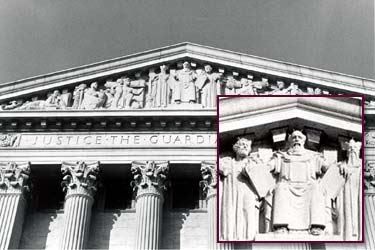
As you walk up the steps to the building which houses the U.S. Supreme Court you can see near the top of the building a row of the world's law givers and each one is facing one in the middle who is facing forward with a full frontal view ... it is Moses and he is holding the Ten Commandments!

Image hosting by Photobucket

Part 1